Xometry Gives UNH the Scale Needed for Multiple NASA Sounding Rocket Missions

When the University of New Hampshire’s in-house machine shop didn’t have the capacity available to rapidly create hundreds of precise instrument parts, Xometry’s fast turnaround and tight tolerances helped them pick up the pace.


The University of New Hampshire (UNH) has worked with NASA for decades, helping the agency launch missions to explore both near-Earth space and the distant universe.
“NASA was founded in 1958, and the first UNH-built instrument to fly to space was on the Explorer 12 satellite in 1961. So we’ve been involved with NASA from pretty much the very beginning,” said Dominic Puopolo, a research project engineer at UNH’s Space Science Center.
UNH’s Institute for the Study of Earth, Oceans, and Space is celebrating 40+ years this year. The scientists who work on the space portion of the program collaborate closely with NASA, usually developing between two and four large-scale missions concurrently at any given time.
Many of these missions include sounding rockets, which are specialized low-altitude rockets designed to carry scientific instruments into the atmosphere. Sounding rockets have a relatively low cost compared to other types of spacecraft, but the quick missions — often just 20 minutes from takeoff to when the rockets crash back to Earth — can come together quickly on tight timelines.


The Challenge: Creating Hundreds of Precise Parts at Scale
One of the key instruments that gets launched into space on sounding rockets is ion gauges, which “measure atmospheric density and variation of density, as well as temperature profiles,” Puopolo said. “So they ride up on rockets, and as they ascend through altitude, they create an altitude profile of the temperature and densities of those locations, which helps us determine atmospheric structure.”
These gauges are commonly used in multiples to collect more information, and it's not uncommon for one mission to call for 10 or more ion gauges. Each instrument comprises hundreds of small parts that must fit together precisely, requiring meticulous manufacturing. Despite having the expertise to fill this order, UNH’s in-house machine shop didn’t have the scale to produce all the parts needed to outfit an entire rocket in a short time period.
“We have a very good machine shop here, but we only have two machinists, and there are a lot of people in the building who want machine shop time. So one of the main reasons we turn to Xometry is because some other project is in the shop and it's going to take three months. There's just not enough manpower here,” Puopolo said. “We can make one or two or three of these instruments and be very happy with the quality, but we can't make 22 of them in a six-month timeframe. It's just not possible.”
When UNH needed to make 10 ion gauges for the TOMEX+ sounding rocket mission in August 2025 and six gauges for the RENU3 mission in November of that year, Puopolo reached out to Xometry to deliver a bill of materials with more than 700 items.
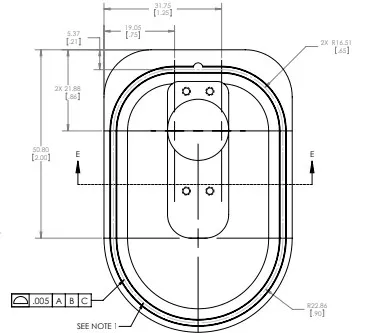
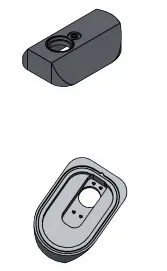


Xometry took UNH's parts from design to finished product in a third of the time it would have taken UNH's in-house machine shop. Swipe through to see the evolution of the door plate from drawing to 3D rendering to finished product (images provided by UNH).
By partnering with Xometry, UNH was able to receive parts for 16 ion gauges in two months — a project that would have taken the in-house machine shop at least six months.
The Solution: Xometry Delivers Tight Tolerances on Tight Timelines
In addition to the tight timelines required to get the gauges ready for the missions in time, all the parts UNH ordered had to be manufactured to precise measurements so they would fit together when welded.
“We have items with really tight tolerances that need to mesh together with other pieces exactly. So those have to be inspected very carefully, and the quality checks and quality assurance and control [that Xometry provides] are very important to us,” Puopolo said.
Xometry’s quoting process made it simple to order the sheet metal and CNC-machined parts, as well as some nickel-plated finishes. “It is intuitive and easy to use the online quoting platform…Everyone's always helpful and adaptable, and if I need to submit something manually, that's very easy to do,” he said.
By partnering with Xometry, UNH was able to receive parts for 16 ion gauges in two months — a project that would have taken the in-house machine shop at least six months.
The quality checks and quality assurance and control [that Xometry provides] are very important to us.Dominic PuopoloResearch project engineer, UNH’s Space Science Center
The Results: A Reliable Partner for Many More Missions to Come
With two successful missions in the book, Puopolo sees a bright future for UNH’s partnership with Xometry. He’s already placed orders for parts that will make up instruments on the upcoming Dynamo3 and EVEX2 missions scheduled for later this year, which will include 12 and 10 ion gauges, respectively.
Puopolo is confident that Xometry will continue to deliver for UNH as they scale up their orders, because the Xometry team acts as an extension of his own.
“Xometry’s quality is more consistently reliable, and the one definite advantage over other vendors is the service,” he said. “The ability to put together a dedicated team on the Xometry side with engineers and project managers is pretty valuable for us, because the reason we would prefer to work in-house is that we have people who've been doing this for 30 years, and they understand what we're trying to do. Whereas if we just send a part to someone and tell them to make it, they don't understand the grand scheme of things and how parts need to work with other parts,” he said. “Being able to send all of our experiential information over to Xometry and have the teams understand and work together … I'm really impressed.”

Top image: RENU3 rocket launches from the Andøya Space Center in Norway (Diana Swanson/UNH)